Journaling is traditionally viewed as a sanctuary, a deeply personal space not intended for outside eyes. Most would agree that the primary goal is internal: working through private thoughts, cultivating gratitude, or simply engaging in a stream-of-consciousness release. In this ritual, there is no external goal or expected outcome. We write because it helps us process life without the burden of performance. We write because it feels good, because we have everything or nothing to say, and because it forces us to slow down. Ultimately, we write for ourselves.
However, when we limit the diary to a strictly internal discussion, we overlook a significant historical and emotional reality. Diaries often transform into family heirlooms, handed down to younger generations to generate a profound sense of understanding. They offer a rare glimpse into the past, showing us how stories truly unfolded from the inside out.
This extends beyond the family unit. Ancient military diaries circulate widely today, providing a visceral, often painful picture of the worlds they inhabited. Many celebrated autobiographies begin as a collection of diary entries. These amalgamations of personal values, perspectives, and raw descriptions of a life lived serve as the most authentic bridge between generations, offering a truth that polished history often erases.
Journal therapy is a writing therapy focusing on the writer’s internal experiences, thoughts and feelings. This kind of therapy uses reflective writing enabling the writer to gain mental and emotional clarity, validate experiences and come to a deeper understanding of themself.
Wikipedia, Journal Therapy
Furthermore, Modern technology has shifted these “snippets of life” into the public eye. The internet has birthed a culture of personal storytelling in which anecdotes are continuously mixed with utilitarian content. We see this in the modern zeitgeist every time we encounter a deeply personal journal entry attached to a digital recipe. While many skip straight to the ingredients, these stories reveal the author’s intent and the life circumstances that birthed the creation.
Web-based services such as Open Diary (started in October 1998) and LiveJournal (January 1999) soon appeared to streamline and automate online publishing, but growth in personal storytelling came with the emergence of blogs. While the format first focused on external links and topical commentary, widespread blogging tools were quickly used to create web journals.
Wikipedia, Diary
Assigning the diary a “private-only” label shortchanges its potential. There is a specific psychological power in having an audience for self-expression, even if that audience is a personified version of the book itself. Anne Frank famously addressed her diary as “Kitty,” finding a strong psychological effect in that imagined connection. Can we extend this audience while also keeping it small? What if the audience were just a few people? Without writing a biography or publishing a journal, it feels to me like there’s potential for sharing in our everyday life.
My own shift toward sharing began years after I started a daily writing practice. I realized that while I struggled to explain my experiences in conversation, I could simply share my raw thoughts as they were formed. This wasn’t “broadcasting” to a public blog; it was “narrowcasting.” Using a simple share button in my journaling app, I began sharing some one-off journal entries. When prompted and sometimes unprompted, I started sending some random writing to friends and family.
Because these entries originated as personal reflections, I didn’t edit them. I didn’t clean up the language or fix the typos. I simply sent my raw feelings, unadulterated by the expectations of a wide audience. There was something incredibly freeing in that lack of polish. I wasn’t worried about being “clear” or “correct”, I was just being.
The feedback was visceral. People responded with a depth that rarely occurs in normal conversation. The reactions weren’t usually about the specific events I wrote about; they were about the act of vulnerability itself. They were about the honesty required to dismantle the social masks we usually wear. It created a level of trust that “small talk” could never reach. I started sharing more often. I started enjoying the feeling of vulnerability and the depth it could create with those around me.
Sharing has now become a part of everyday life for me. I find myself wanting to share parts of my days with close friends. Sometimes with the people I talk to every day, and other times with some whom I rarely see. Sometimes I’ll mention a story or an adventure that included that person. I share the entry where I thought about them throughout that day. Sometimes I’ll dig up the adventure itself and send it along as well. It’s an easy way to rekindle a friendship and collectively remember good times together. What if everyone shared these? What if we used this reflection as a way to reconnect? What if we told each other how much we missed each other? What if we picked up the phone and called that person after sharing our thoughts? What if this interaction leads to more quality time with your favourite people? I think that’s a world I would like to be part of.
There is something transformative about being vulnerable with the people you love. You might start a journal for yourself, or to remember a moment, and you may never intend for those words to leave the page. But when the time is right, sharing those thoughts can pay dividends in honesty. It creates a shared understanding of the human experience. If we shared how we truly felt more often, we might find ourselves supported in ways we never thought possible, turning a solitary act of reflection into a communal act of connection.
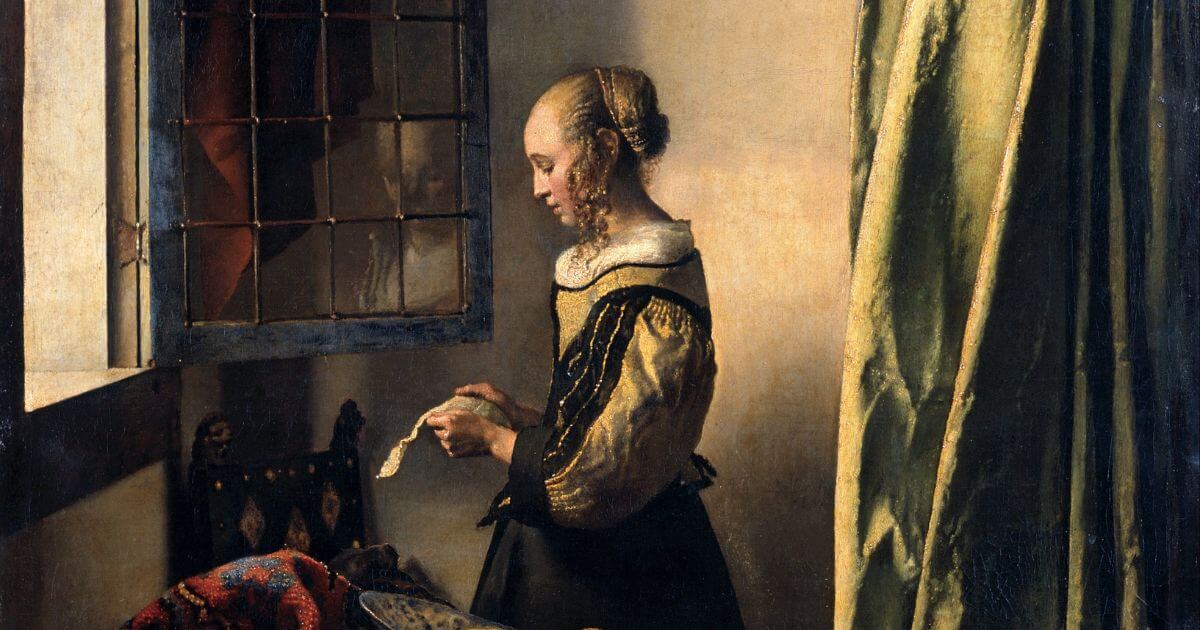
Image credit: “Girl Reading a Letter at an Open Window” by Johannes Vermeer, appx. 1657-1659